Since Brexit, British citizens who do not live in Spain can spend up to 90 days in any 180-day period here without a visa. That rule has applied since January 1, 2021, and since April 10, 2026, the days have been counted electronically at the border.
Living in Spain Travel and borders
Post-Brexit Travel Rules for Swallows & Second Homeowners in Spain

This matters most to those who are non-residents and travel between the UK and Spain (often referred to as ‘Swallows’), and to anyone who owns a second home here.
Below we outline the most common questions ‘Swallows’ have: how the 90 days are counted, what you may be asked for at the border, what owning a home in Spain does and does not allow, and the legal ways to stay longer.
Facts checked on November 12, 2026.
What is a ‘Swallow’?
A ‘Swallow’ other than being a small bird, is also a term used for someone who is not permanently resident in Spain, however, they may regularly travel between the UK and Spain for their holidays throughout the year.
Some of these people may also be second homeowners in Spain, either renting out their property or using it themselves throughout the year as a holiday home.
The 90/180-day rule
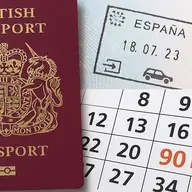
As a British visitor, you can stay in Spain for up to 90 days in any 180-day period without a visa. This is European Union (EU) law, and it covers the whole Schengen area (the European zone without internal border checks), not just Spain.
Before Brexit it was different. Speaking in 2020, as British Consul in Malaga, Charmaine Arbouin described the change like this.
“Up until now, UK citizens have been able to come to Spain for whatever length of time they wanted. Most people would come for maybe four or five months over the winter.
“Brits are right in thinking that after the transition period, those who are not resident in Spain or other parts of the EU will only be able to spend 90 days in every 180-day period here.
“As far as we are aware, the clock will start ticking from the first point in which you enter the Schengen area.
“And it’s really important that people know that that’s not from the moment that you reach your final destination but rather when you first enter the Schengen area.
“You may be destined for the south of Spain but if you drive through France from the UK, which is when the clock starts," Arbouin said.
That is still how it works today. The 180 days roll forward every day. On any day of your stay, look back 180 days and add up the days you have spent in the Schengen area. The total must be 90 or fewer.
The day you arrive and the day you leave both count. Days spent in any other Schengen country count too, and since July 15, 2026, so do days in Gibraltar. There is no limit on the number of trips, only on the total days.
Can I join two 90-day periods together?
Unfortunately not. You will not be able to stay for 180 days consecutively by combining two 90-day periods.
Once you have been in Spain for 90 days, you will need to leave the Schengen area.
If you have just spent 90 days in a row here, you then need 90 days in a row outside the Schengen area before you have a fresh 90. For example, if you arrive on November 1, 2026, and stay for 90 days, you must leave by January 29, 2027, and you cannot return until April 30, 2027.
So the four or five months over the winter that many Swallows used to spend here are no longer possible without a visa. A weekend back in the UK does not reset anything. It only pauses the count.
Another option is to split the 90 days into shorter trips, such as two 45-day periods within the 180 days. Each day comes back to you once it drops out of the 180-day window. The count still runs from when you first enter the Schengen area, not from when you reach Spain.
If you are unsure, check your dates on the European Commission’s short-stay calculator below.
European Commission: Calculator
How will they know how long I have been in Spain?
Since April 10, 2026, the EU’s Entry/Exit System (EES) has counted your days electronically at every external Schengen border, in place of passport stamps. Our guide to the EU biometric border checks explains how it works.
If you stay past your 90 days, the system flags it automatically. Our article on overstaying the 90 days in Spain covers the fines and what to do.
Private cover in Spain
Pick up your Sanitas quote
See a doctor or specialist privately instead of waiting your turn. Sanitas plans from €22,10 a month.
Your saved quote is ready whenever you are. Compare plans and finish in minutes.
Get a price My quotesPassport requirements
Those who live in the UK and wish to travel to Spain and other parts of the EU need a passport that is valid for at least 3 months after the day they plan to leave the Schengen area.
Passports must also have been issued less than 10 years before the date you enter the country. You will need to check the ‘date of issue’ on your passport.
This catches some people out. If you renewed your passport before October 1, 2018, extra months may have been added to its expiry date, so it can be more than 10 years old on the day you travel even though it has not expired. Check both dates before you book. Our passport validity guide has worked examples.
If you are officially resident in Spain, the 90-day limit on your time in Spain does not apply to you. Always carry your passport and your TIE residencia card when you travel, and show both at passport control, to prove that you are a resident and not a Swallow. With a biometric TIE you are not registered in the EES. The old green residence certificate does not do this, so exchange it for a TIE.
Second homeowners: what you can and cannot do
Q. Does the 90/180-day rule apply to me if I own a holiday home?
A. Yes, it does. Owning a home in Spain gives you no right to stay past 90 days, even if you pay local taxes on it. There is no special arrangement for second homeowners, and buying a property does not lead to residence.
Q. What can I do as a second homeowner?
A. You can come and go as often as you like, as long as your total stays within 90 days in any 180. You can use your home yourself or rent it out. What you cannot do as a visitor is take a job in Spain, or stay on after your 90 days because you own a property here.
What you may be asked for at the border
Border officers can ask any visitor for a return ticket, proof of money for the stay and proof of where they will stay. If you are staying at your own property, carry proof of your address there. Our guides cover how much money you have to show and the letter of invitation for guests staying with family or friends.
How to stay longer than 90 days
You cannot simply stay on after a visit, and there is no way for a retired visitor to apply for residence from inside Spain. To spend the whole winter here you need a visa, and you apply for it from the UK before you travel. For most Swallows that is the non-lucrative visa. Our guide to the non-lucrative visa explains the income you must show, the health insurance the consulate accepts and how to apply.
Bear in mind that this is a visa for living in Spain, not for a longer holiday. To renew it, you must have lived in Spain for more than 183 days in the calendar year, and anyone who spends more than 183 days in Spain in a calendar year is also tax resident here.
Other Common Questions
Q. If I am travelling to and from Spain, which queue do I use at the airport?
A. Use the desks staffed by border officers, and use the e-gates only if airport staff tell you to. If you are resident in Spain, show your TIE card with your passport.
More in Travel, borders and the 90-day rule 10 guides and 4 articles
 ETIAS for Spain: Start Date, Cost and Who Needs One
 Border Checks in Spain: What Officers Can Ask at Schengen Entry
 Carta de Invitación: Requirements for Hosting Friends or Family in Spain
 Passport Validity Rules: What Brits Travelling To Spain Need To Know
 Which Line Should British Passport Holders Queue In At Spain’s Airports?
Read next

Reviewed by Sean Guy, authorised Sanitas agent (agent code 22395) and DGSFP-registered insurance mediator (C0320X5769518Z), Marbella.
Written by the HealthPlan Spain team: English-speaking Sanitas health insurance specialists, helping expats in Spain get the right cover since 2011. Authorised and regulated by the DGSFP.