Miscarriage in Spain: Signs, Causes, What Happens Next and What Sanitas Covers
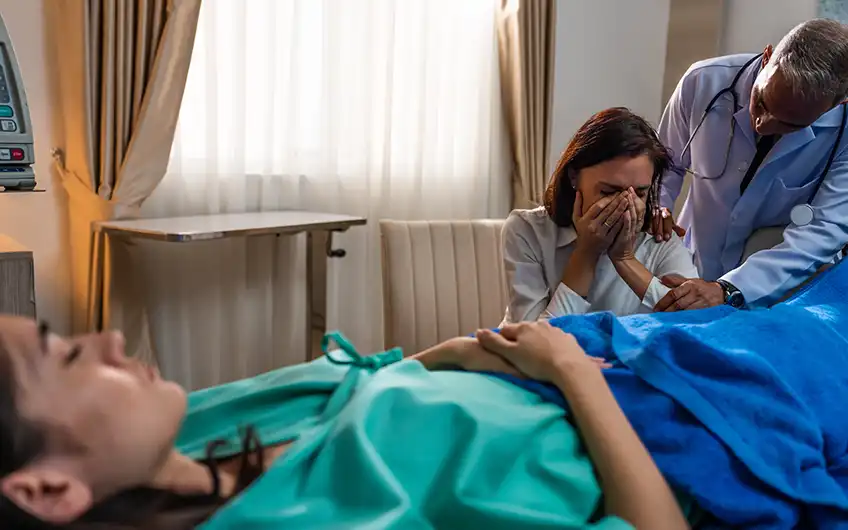
A miscarriage in Spain is treated in the emergency department, day or night, by a gynaecologist on call. If you are bleeding heavily, in severe pain, feverish or faint, call 112 or go straight to the nearest hospital. On a Sanitas policy the consultation, the blood tests and a scan in the consulting room are covered from the first day. A life-threatening loss is treated at once whatever the policy date, provided the pregnancy is not excluded from your policy, and planned surgical treatment follows the plan's ordinary waiting periods. Between 10 and 20 per cent of known pregnancies end in miscarriage, most of them in the first 12 weeks, and most for a reason nobody could have prevented. This guide explains the signs, the causes and the numbers, then what happens in Spain, what Sanitas covers and when, sick leave and paperwork, and what the care costs without insurance.
Routine pregnancy care and booking a gynaecologist are in our gynaecology and pregnancy care guide, and midwives in our midwives guide. Pregnancy cover and adding a newborn are in our family health insurance guide.
Signs of a miscarriage, and when to go now
The commonest sign is vaginal bleeding before 22 weeks, with or without cramping in the lower stomach or back. Light spotting in the first weeks is common and often means nothing, but any bleeding in pregnancy should be checked the same day. Pregnancy symptoms such as breast tenderness and nausea fading can be a sign, and so can passing fluid or tissue. Some women have no symptoms at all and the loss is found at a routine scan.
- Call 112 or go to the nearest emergency department for heavy bleeding: a large pad soaked within two hours, or bleeding heavier than a period with clots. Do the same for severe or one-sided pain, pain in the tip of the shoulder, fainting or dizziness, or a fever. Pain in one side and shoulder-tip pain can mean an ectopic pregnancy, which is an emergency.
- Go to a Sanitas network emergency department or ring your gynaecologist today for lighter bleeding, cramping or a sudden loss of pregnancy symptoms. A gynaecologist confirms what is happening with a transvaginal ultrasound scan and a blood test for the pregnancy hormone, sometimes repeated 48 hours apart.
- Do not use the emergency video service for bleeding in pregnancy. It is staffed by general practitioners and paediatricians; a pregnancy loss needs an examination and a scan, so go in person.
Causes, and how common it is
Most early miscarriages happen because the embryo has a chromosomal abnormality that stops it developing; the loss is the body's response, not the result of anything you did. Other causes are less common: clotting disorders such as antiphospholipid syndrome, thyroid disease and poorly controlled diabetes, a weak cervix or an abnormally shaped womb, and some infections. Smoking, heavy drinking and obesity raise the risk. Everyday exercise, sex, stress, lifting and a fright do not cause a miscarriage.
Between 10 and 20 per cent of clinically recognised pregnancies end in miscarriage, and more than 80 per cent of those losses happen in the first 12 weeks. Age is the strongest risk factor. In a study of 421,000 Norwegian pregnancies the overall rate was 12.8 per cent: about 10 per cent at 25 to 29, rising steeply after 30 to 53 per cent at 45 and over. One earlier miscarriage raises the risk of another by half; after three in a row it is four times higher. Even so, most women who have had a miscarriage go on to have a healthy pregnancy.
Recurrent miscarriage means two or more losses under the European guideline Spanish gynaecologists follow, or three under the British one, and affects 1 to 2 per cent of couples. That is the point at which investigations are offered, covered below.
Miscarriage or stillbirth: the Spanish definitions
Spanish obstetricians count a loss before 22 completed weeks, or of a baby weighing under 500 grams, as a miscarriage, aborto espontaneo. After that it is a fetal death and is treated as a stillbirth. Britain and Ireland draw the line at 24 weeks, so the words you grew up with do not match the Spanish ones. A third line matters for paperwork. A baby lost after six months of pregnancy, about 25 weeks and five days, is entered in a Civil Registry archive, and you may give the baby a name. The mother's time off then follows the maternity rules. The paperwork section below explains it.
The word aborto on its own covers any pregnancy loss in medical Spanish. You will see it on the hospital report. Sanitas excludes a voluntary termination of pregnancy, interrupcion voluntaria del embarazo, not a miscarriage. Other words you will meet: amenaza de aborto (threatened miscarriage, bleeding with a closed cervix), aborto diferido or retenido (missed miscarriage) and aborto incompleto. In the treatment room: legrado (surgical evacuation), aspiracion (suction evacuation), sangrado (bleeding), ecografia (ultrasound scan) and gammaglobulina anti-D.
What happens in Spain
Pregnancy loss is managed from the hospital emergency department, not from a general practitioner's (GP) surgery. Public hospitals with a maternity unit have a gynaecologist on call around the clock; Marbella's public Hospital Costa del Sol has two on site day and night, though Sanitas does not pay for care there. Many Sanitas network hospitals run their own emergency departments, and Sanitas' La Zarzuela and La Moraleja hospitals in Madrid and its CIMA hospital in Barcelona have 24-hour gynaecology and obstetric emergencies. Our emergencies guide explains 112, ambulances and network hospitals.
Once a miscarriage is confirmed there are three ways to manage it, and in Spain as in Britain the choice is yours where it is safe. Waiting for the loss to complete on its own works for 40 to 70 per cent of women within one to two weeks. Medical management uses misoprostol tablets, given in the clinic and sometimes preceded by mifepristone; it works in roughly 85 per cent of cases and you go home with a review one to two weeks later. Surgical management is a suction evacuation, legrado por aspiracion, under local or general anaesthetic, usually as day surgery and with a success rate around 95 per cent. From 12 weeks the loss is managed in hospital.
Two Spanish habits to know. Women with a rhesus-negative blood group are given anti-D immunoglobulin after medical or surgical treatment and after any loss beyond eight weeks, so expect a blood group test. And the tissue is routinely sent to the pathology laboratory, so ask for the result if you want it. You leave with an informe de alta, the discharge report; keep it, because the sick note and any later investigation start from it.
What Sanitas covers, and when
Every Sanitas plan with hospital cover, apart from the International Students plan, pays for the treatment of a miscarriage. That includes Sanitas Mas Salud, Optima, Plus, Mas Salud Family, Top Quantum, Mas 90, Premium 500 and Sanitas Residents Visa, and the Sanitas Professional plans for the self-employed. The gynaecologist's consultation, the blood tests and a scan done in the consulting room are covered from the first day of the policy. The emergency department visit is covered on every plan; on the copayment plans it carries the plan's emergency copayment. A hospital admission means a single room with a bed for a partner. Accede covers the consultation, blood tests, a scan in the consulting room and the emergency visit, but no surgery of any kind and no hospital stay. Avanza adds complex tests and more than 400 outpatient surgical procedures, but no hospital stay. Unico covers no surgery at all, and the International Students plan excludes maternity care.
Waiting periods are where a new policy matters, and the eight months for childbirth are not the issue: they apply to the delivery only. A pregnancy loss falls under the ordinary rules of the plan. On the Mas Salud range and Family, a scan in the radiology department waits six months, a minor operation three months, and a hospital admission or major surgery ten months. On Top Quantum every operation and admission waits eight months, and Residents Visa has no waiting periods at all. Our waiting periods guide has every plan's table.
The exception that matters most: no waiting period applies to an illness or accident that is life-threatening, unexpected and diagnosed after the policy started, provided the care is covered by your plan. Life-threatening bleeding, a suspected ectopic pregnancy or a serious infection after a loss meets that test, and the hospital treats you under the policy from the first day. A missed miscarriage found at a routine scan on a two-month-old Mas Salud, Optima or Plus policy is different. The scan and the consultation are covered, but planned surgical management falls inside the three-month or ten-month wait. Residents Visa has no waiting periods, so none of this applies to it. If your policy is under ten months old, ring us before the procedure is booked and we confirm what is covered.
- Surgery. A suction evacuation or curettage needs a written prescription from a Sanitas gynaecologist and Sanitas' authorisation; in an emergency the hospital arranges it. The theatre, the anaesthetist, the medicines used in hospital and the day-hospital or overnight stay are covered.
- Medicines. Medicines given to you during a hospital admission, including those used in the operating theatre, are part of the treatment. Tablets given in the clinic or a day hospital, and any medicine you take at home, are not covered on any Sanitas plan; a tablet prescribed for home is paid at the pharmacy.
- Ambulance. A Sanitas ambulance is covered when you cannot safely travel any other way and the 24-hour line authorises it. In a life-threatening emergency call 112 and go where the ambulance takes you; a public ambulance is outside the Sanitas policy.
- A public hospital. If the ambulance takes you to a public hospital, the public hospital treats you. Sanitas does not pay for treatment in a public hospital or outside its network. Tell Sanitas as soon as you can and keep every document you are given; it moves you to a network hospital when it is safe. A family with a right to the public system pays nothing there. Our public versus private healthcare guide explains who has that right.
- Already pregnant when you joined. The pregnancy is declared on the health questionnaire and Sanitas decides how it is treated. If Sanitas accepts the pregnancy without excluding it, antenatal appointments and the treatment of a loss are covered under the plan's ordinary waiting periods; the birth is not. Our pre-existing conditions guide explains how Sanitas decides.
After the loss: follow-up, psychology and tests
A follow-up consultation and scan with the gynaecologist are covered like any other consultation. Grief after a miscarriage is real and often lasts longer than people expect. Mas Salud Family gives each insured person 20 psychology sessions a year with no prescription and no waiting period. Mas Salud, Optima and Plus give 15 sessions a year, prescribed by a Sanitas GP, psychiatrist, paediatrician or oncologist and authorised by Sanitas, after a six-month wait. Top Quantum gives 20 after three months, and Residents Visa gives 15 with no wait. A psychiatrist's consultation is covered from the first day on every plan except Avanza, and the digital psychology programme in the app is open from the day you join. Our mental health cover guide has the routes. Outside the policy, Spain's perinatal grief charity Umamanita publishes guides in Spanish, and the 024 helpline for anyone with suicidal thoughts is free and open around the clock.
After two or more losses, Spanish gynaecologists investigate. Sanitas covers a karyotype test for the insured woman. It also covers the Factor V Leiden and prothrombin gene mutation tests, with prior authorisation, when there is a personal history of recurrent miscarriage; any other genetic test is excluded. Blood tests for thyroid function, antiphospholipid antibodies and clotting are covered as ordinary blood tests. A pelvic ultrasound in the radiology department or a hysteroscopy is a complex test, covered after six months and, for fertility, up to the point of diagnosis. Fertility treatment itself, including in vitro fertilisation (IVF), is not covered on any plan. Sanitas' La Moraleja hospital in Madrid offers a repeated-miscarriage study.
Sick leave and paperwork in Spain
Since 1 June 2023 Spanish law gives a special sick leave for the interruption of a pregnancy, voluntary or not, while you are under the care of the public health service. A miscarriage qualifies. Social Security pays it from the day after you stop work, with no minimum contribution record. Your employer pays the first day in full; Social Security then pays 60 per cent of your contribution base to the twentieth day and 75 per cent from the twenty-first. It covers employees and the self-employed alike; a self-employed woman has no employer to pay the first day, and her mutua pays the benefit from the second day. The guide length in the Social Security manual is seven days for a miscarriage and fourteen for a threatened one, but your doctor sets the dates.
The sick note, the parte de baja, is issued by the public health service doctor at your health centre, never by a private gynaecologist. Take the hospital discharge report with you. A partner has five days' paid leave under the Workers' Statute when you are admitted to hospital or have surgery that needs rest at home. A loss after six months of pregnancy is different again. The mother takes maternity leave, and the hospital files a declaration with the Civil Registry in which you may give the baby a name. A family can ask the hospital in writing for the baby's remains to bury or cremate, whatever the stage of pregnancy. Umamanita's guides walk parents through those steps.
Trying again
You can try again as soon as the bleeding has stopped and you both feel ready. Neither the National Health Service (NHS) nor the Royal College of Obstetricians and Gynaecologists sets a waiting time, and Spanish gynaecologists usually suggest waiting one or two periods so the next pregnancy can be dated. Your Sanitas cover carries on unchanged, and nothing about a miscarriage has to be re-declared. The eight-month childbirth waiting period counts from the day your policy started, not from the loss. A pregnancy that begins after your start date is covered for the birth once the eight months have passed, and antenatal care is covered before that. Our gynaecology and pregnancy care guide covers the appointments and scans of the next pregnancy.
What it costs without insurance
Sanitas' own pay-as-you-go portal sells a gynaecology consultation from €70 and an ultrasound scan from €85 to anyone, insured or not. A private surgical evacuation in a Spanish hospital is listed at roughly €900 to €1,150, with follow-up consultations extra. In Britain a private manual vacuum aspiration costs around £1,400 and a surgical evacuation from about £2,800. A resident with a right to the Spanish public system pays nothing at a public hospital. On a plan with hospital cover the consultation, the scan, the emergency visit and the surgery are covered as set out above; compare the plans on our calculator to see them side by side.
Frequently asked questions
- What should I do if I think I am having a miscarriage in Spain?
-
If you are bleeding heavily, soaking a large pad within two hours, or have severe pain, shoulder-tip pain, a fever or faintness, call 112 or go straight to the nearest emergency department. A suspected ectopic pregnancy is treated the same way. For lighter bleeding or cramping, go to the emergency department of a Sanitas network hospital or ring your gynaecologist the same day. A gynaecologist on call confirms what is happening with a scan and a blood test. Do not wait for a routine appointment.
- Is a miscarriage covered by Sanitas health insurance?
-
Yes, on every plan with hospital cover: Mas Salud, Optima, Plus, Mas Salud Family, Top Quantum, Mas 90, Premium 500, Residents Visa and the Professional plans for the self-employed. The consultation, blood tests and a scan in the consulting room are covered from the first day. Planned surgical or hospital management carries the plan's normal waiting periods on a new policy. A loss that is a life-threatening emergency is covered at once whatever the policy date, provided the pregnancy itself is not excluded from your policy. Accede, Avanza and Unico do not cover hospital treatment, and the International Students plan excludes maternity.
- Does the eight-month childbirth waiting period apply to a miscarriage?
-
No. The eight months apply to the delivery or caesarean only. A pregnancy loss falls under the ordinary rules. Consultations, blood tests and a scan in the consulting room are covered from day one, and a scan in the radiology department after six months. A minor operation waits three months and a hospital admission or major surgery ten. On Top Quantum both wait eight months, and Residents Visa has no waiting periods. A life-threatening emergency overrides all of them.
- Is a miscarriage covered if I was already pregnant when I took out the policy?
-
The pregnancy is declared on the health questionnaire and Sanitas decides how it is treated when you join. If Sanitas accepts the pregnancy without excluding it, routine antenatal appointments and the treatment of a loss are covered under the plan's ordinary waiting periods; the birth is not. Tell us you are pregnant when you apply, or ring us now if you already hold the policy, and we will tell you what Sanitas agreed.
- Does Sanitas cover a D&C (dilatation and curettage) or surgical evacuation after a miscarriage?
-
Yes, on the plans with hospital cover, once the plan's waiting period has passed or when the loss is a life-threatening emergency. Surgical management needs a written prescription from a Sanitas gynaecologist and Sanitas' authorisation, which the hospital arranges for an emergency. The operating theatre, anaesthetist, the medicines used in hospital and the room are covered.
- Does Sanitas cover the medication used to manage a miscarriage?
-
Medicines given to you during a hospital admission, including those used in the operating theatre, are covered as part of the treatment. Tablets given in the clinic or a day hospital, and any medicine you take at home, are not covered on any Sanitas plan; a tablet prescribed for home is paid at the pharmacy.
- Can I get sick leave in Spain after a miscarriage?
-
Yes. Since 1 June 2023 a miscarriage gives a special sick leave while you are under the care of the public health service. Social Security pays it from the day after you stop work, with no minimum contribution record. Your employer pays the first day; Social Security pays 60 per cent of your contribution base from the second to the twentieth day and 75 per cent from the twenty-first. It covers employees and the self-employed alike; a self-employed woman has no employer to pay the first day, and her mutua pays the benefit from the second day. The sick note is issued by your public health centre doctor, not by a private gynaecologist, so take the hospital discharge report to your health centre.
- What is the Spanish word for miscarriage?
-
Aborto espontaneo. In medical Spanish "aborto" on its own covers any pregnancy loss, including a miscarriage, which is why you will see it on hospital paperwork. A termination is an interrupcion voluntaria del embarazo, or aborto voluntario, and that is what Sanitas excludes, not a miscarriage. Other words you will meet are amenaza de aborto (threatened miscarriage), aborto diferido (missed miscarriage), legrado (surgical evacuation), sangrado (bleeding) and ecografia (ultrasound scan).
- When is a pregnancy loss a stillbirth in Spain?
-
Spanish obstetricians count a loss before 22 completed weeks, or of a baby under 500 grams, as a miscarriage; after that it is a fetal death, treated as a stillbirth. Britain and Ireland draw the line at 24 weeks. A baby lost after six months of pregnancy, about 25 weeks and five days, is entered in a Civil Registry archive, and you may give the baby a name. The mother's leave then follows the maternity rules rather than sick leave.
- Does Sanitas cover psychological support after a miscarriage?
-
Yes. Mas Salud Family gives 20 psychology sessions a year with no prescription and no waiting period. Mas Salud, Optima and Plus give 15 sessions a year, prescribed by a Sanitas GP, psychiatrist, paediatrician or oncologist and authorised by Sanitas, after a six-month wait. Top Quantum gives 20 after three months, and Residents Visa gives 15 with no wait. A psychiatrist's consultation is covered from the first day on every plan except Avanza, and the app's digital psychology programme is available from the day you join.
- Does Sanitas cover tests for recurrent miscarriage?
-
Sanitas covers a karyotype test for the insured woman, and the Factor V Leiden and prothrombin gene tests with prior authorisation when there is a personal history of recurrent miscarriage. Other genetic tests are excluded. Blood tests such as thyroid and clotting screens are covered as ordinary tests, and a hysteroscopy or a scan in the radiology department as complex tests after six months. Fertility treatment itself is not covered on any plan.
- How soon can we try again after a miscarriage?
-
Medically, as soon as your bleeding has stopped and you both feel ready. Neither the NHS nor the Royal College of Obstetricians and Gynaecologists sets a waiting time, and Spanish gynaecologists usually suggest waiting one or two periods. Your Sanitas cover carries on unchanged. The eight-month childbirth waiting period counts from the day your policy started, not from the loss. A pregnancy that begins after your policy start date is covered for the birth once the eight months have passed.
- What does miscarriage care cost in Spain without insurance?
-
Sanitas' own pay-as-you-go portal sells a gynaecology consultation from €70 and an ultrasound scan from €85. A private surgical evacuation in a Spanish hospital is listed at roughly €900 to €1,150, with follow-up consultations extra. In Britain a private manual vacuum aspiration is around £1,400 and a surgical evacuation from about £2,800. A resident with a right to the Spanish public system pays nothing at a public hospital.
Cover for pregnancy, birth and everything around it
Compare the Sanitas plans with hospital and maternity cover side by side, with and without copayments.