Spain has three main police forces, plus regional ones. The Policía Nacional (call 091) handles serious crime, national security and paperwork such as your NIE in cities. The Guardia Civil (062) is a military-status force covering rural areas, traffic on main roads, borders and the coast. The Policía Local (092) deals with town-level matters like traffic and parking. Some regions also have their own force, such as the Mossos d’Esquadra in Catalonia.
Living in Spain Police and paperwork
Police In Spain: A Guide To The Three Spanish Police Forces
| Force | Main role | Number |
|---|---|---|
| Policía Nacional | Serious crime, national security, ID/NIE, immigration (cities) | 091 |
| Guardia Civil | Rural areas, traffic on main roads, borders, coast, firearms | 062 |
| Policía Local | Town matters: traffic, parking, local bylaws | 092 |
| Regional police | Autonomous forces (Mossos d’Esquadra, Ertzaintza, etc.) | 112 |
2025 update: Spain has strengthened police coordination, expanded online reporting services, and clarified powers for traffic enforcement and documentation checks. Expats should be aware that ID requirements and reporting procedures remain strictly enforced.
One thing that really stands out when you first move to Spain is just how many police officers there are on the streets. Although it can be very reassuring to know that they are there to protect us, there can be some confusion over the different roles they play in keeping us safe. There are three main police forces in Spain which are defined by not only the uniforms they wear but also their appearance and the roles they undertake.
Below we explain what each of the three Spanish police forces is and how they help to keep the country safe and secure.
Local or Municipal Police
Who the Policía Local are
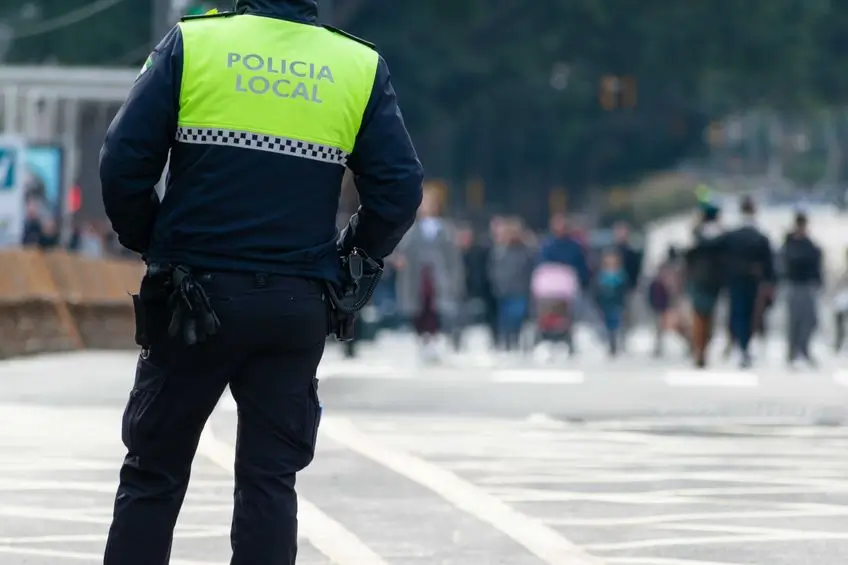
Recognised by their blue uniforms, the Local or Municipal police are a common sight and are attached to and recruited by the local town halls.
In some areas including Madrid and Valladolid, they are referred to as Municipal Police (Policía Municipal), whereas in Barcelona they are called ‘Guardia Urbana’. In the vast majority of cities and towns, they are called the Local police or 'Policía Local'.
You will usually find local police where the municipality has a population of more than 5,000 people.
There are currently around 70,000 local police officers throughout Spain serving the 17 autonomous communities.
Like all police officers in Spain, the local police are armed.
When not walking the beat, they will usually be found driving around in white and blue patrol cars.
Main responsibilities of the Local Police
Some of their main responsibilities include:-
- Order and control of traffic in urban areas including parking tickets and on-the-spot fines.
- Reporting of traffic accidents in urban areas and managing road closures and diversions.
- Protection of property and prevention of minor crime such as vandalism and petty theft.
- Dealing with civil disturbances and neighbourhood disputes.
- Cooperating in the resolution of private conflicts and referring cases to other authorities where necessary.
- Monitoring and securing of public spaces and events including fiestas, concerts and demonstrations.
- Liaising with other agencies and security forces when required.
Local police are also responsible for enforcing municipal bylaws, which can include noise complaints, terrace and bar opening hours, public drinking, dog control and local business licensing. In some municipalities, they may carry out routine ID checks in public areas to verify identity, address and vehicle documentation, especially during local campaigns on traffic, noise or public order.
The Local Police can also be considered guardians of the town and will protect local authorities and their official buildings. In resort areas, many of the local police officers will speak English. If you need to report a minor crime (denuncia) such as theft, parking issues, traffic control or bylaw infringements, you can call the Local police on 092.
National Police (Policía Nacional)
Role of the National Police
Spain’s national police (Policía Nacional) is an armed civil force that deals with more serious crimes.
Unlike the Local police which are connected to the town halls, the national police are managed by the Directorate General of Police and Civil Guard. This means that they are under the authority of the State Department of Security in the Ministry of the Interior.
As of 2020, there are over 87,000 Policía Nacional officers who operate in all the capital cities of Spain’s 50 provinces and others as designated by the national Government. They can be identified by their black uniforms and are normally stationed in larger towns and cities with a population of over 20,000.
Crimes and services handled by Policía Nacional
The type of crimes they deal with includes sexual assaults, muggings, violent crime and drug offences as well as organised crime, border control and terrorism. They maintain and/or restore public order and security, which means they are often deployed during large demonstrations, football matches and high‑risk events.
The national police are also responsible for the issuance of national identity documents such as NIE, TIE, DNI and passports. Many Foreigner’s Offices (Extranjería) are co‑located with or managed by Policía Nacional, so expats will often deal with them for residency, fingerprints and ID renewals.
In urban areas, Policía Nacional conduct crime investigation (robberies, cybercrime, fraud, domestic violence and organised gangs), as well as identity and immigration checks where there is a legal basis, for example at transport hubs or during specific operations.
They also staff passport control at most international airports and some ports, where they handle entry and exit checks, Schengen stamps and documentation issues for non‑EU nationals. National police officers in Spain can often be seen at road checkpoints where they can sometimes be heavily armed.
Three of the country’s autonomous communities have their own police forces that are overseen by their regional governments. These are the Basque Country (Ertzaintza), Catalonia (Mossos d'Esquadra) and Navarre (Policía Foral), which take on many of the functions of Policía Nacional and Guardia Civil within their territories.
If you need to report a more serious crime such as robbery or violent crime call 091. You can also visit the Policía Nacional or follow them on X.
Private cover in Spain
Pick up your Sanitas quote
See a doctor or specialist privately instead of waiting your turn. Sanitas plans from €22,10 a month.
Your saved quote is ready whenever you are. Compare plans and finish in minutes.
Get a price My quotesThe Civil Guard (Guardia Civil)
Who the Guardia Civil are
Spain’s Civil Guard or Guardia Civil is the country’s oldest law enforcement agency which comes under the Directorate General of Police and Civil Guard and the authority of the State Department of Security in the Ministry of the Interior.
Guardia Civil officers wear a distinctive dark-green uniform and are responsible for patrolling Spain's highways and rural areas (excluding the Basque Country, Catalonia and Navarre) as well as security and border patrol. You can often see them in pairs riding motorcycles attending serious traffic accidents and security checkpoints.
Founded in 1844, the Guardia Civil is military by nature, which means that officers are usually found in barracks or ‘Casas Cuartel’ rather than in police stations like Spain’s other law enforcement agents.
Duties and specialisations of Guardia Civil
Their remit is far-reaching. Guardia Civil officers can be highly trained in many aspects of law enforcement including fiscal matters, cybercrime, explosives, surveillance, counterterrorism, mountain search and rescue and criminology to name just a few.
On the roads, the Guardia Civil’s traffic unit (Tráfico) focuses on intercity highways and rural routes, setting up roadside checks to enforce speed limits, drink‑driving rules, vehicle ITV (MOT) compliance, insurance and documentation. Learn more about staying legal as a driver in our guide to Spanish car road tax (IVTM).
They have important roles in drug trafficking and border control, particularly at land borders, ports and along known smuggling routes. The Guardia Civil’s maritime service (Servicio Marítimo) patrols coastal waters, supports search and rescue, and works on anti‑smuggling and immigration operations at sea.
There are currently around 75,000 Guardia officers serving Spain’s rural communities with around 10,000 working within the traffic department monitoring the country’s highways.
If you need to contact the Guardia Civil directly, you can reach them on 062. You can also visit the Guardia Civil or follow them on X.
Emergency numbers and who to call
Key police and emergency contacts in Spain
If you are in any doubt about who to call, you can ring the main emergency number in Spain which is 112. The operator can then route your call to the appropriate police force, ambulance service or fire brigade, and in many areas you can get assistance in English and other languages.
Despite rumours of corruption within the Spanish police forces, you will generally find Spanish police officers to be very polite, helpful and extremely professional.
Unless of course, you give them a reason not to be.
See our other article for a list of emergency numbers in Spain.
Final thoughts
Staying safe and informed as an expat
Spain’s police forces may seem complex at first, but understanding who does what makes everyday life much less stressful. Once you know which force handles local issues, serious crime and rural or highway incidents, it becomes much easier to get the right help quickly when you need it.
As an expat, the most important habits are simple: always carry valid ID, keep your vehicle paperwork up to date, and don’t hesitate to call 112 if you are unsure which service to contact. With a bit of familiarity, Spain’s strong police presence becomes a reassurance rather than a source of confusion.
Frequently asked questions
What is the difference between the National Police and the Guardia Civil in Spain?
The Policía Nacional works mainly in cities and larger towns, handling serious crime and official paperwork like the NIE. The Guardia Civil is a military-status force covering rural areas, main-road traffic, borders and the coast. Their duties overlap, but which one you deal with usually depends on where you are.
What is the Guardia Civil?
The Guardia Civil is one of Spain’s two national police forces. It has military status and is responsible for rural policing, traffic on inter-urban roads, coastal and border control, and firearms and explosives.
What are the national police forces in Spain?
Spain has two national forces: the Policía Nacional (091) for cities and serious crime, and the Guardia Civil (062) for rural areas, roads and borders. On top of these are local (municipal) and some regional police.
How do I contact the local police in Spain?
Call the Policía Local on 092, or use 112 for any emergency. To report a crime you file a denuncia at the nearest station. See our guide to emergency numbers in Spain.
Do I have to carry ID in Spain?
Yes. Both Spanish citizens and foreign residents are legally required to be able to identify themselves, which in practice means carrying a DNI, TIE card or passport. If you do not have your ID on you, police can ask you to accompany them to a station to verify your identity.
Which police force do I call in an emergency?
If you are unsure, call 112 and the operator will direct your call to the appropriate service. For specific police numbers, you can call 092 (Local Police), 091 (Policía Nacional) or 062 (Guardia Civil), depending on where you are and the type of incident.
Can police stop me and ask for documents?
Yes. All three forces can carry out identity and documentation checks in certain circumstances, for example at road checkpoints, in transport hubs or during specific operations. You may be asked for ID, driving licence, vehicle registration, insurance and proof of ITV if you are driving.
What number do I call if I don’t speak Spanish?
Dial 112 for emergencies. In many regions, operators can provide support in English and sometimes other languages, especially in areas with a high number of tourists and expats.
How do I report a crime in Spain?
Non‑urgent crimes can usually be reported in person at a police station (Local Police, Policía Nacional or Guardia Civil depending on the case) by filing a denuncia. For guidance on the process, see our dedicated article on how to report a crime in Spain.
What happens if I refuse to show ID?
If you refuse to identify yourself or do not have ID on you, the police can detain you for the time needed to verify your identity and may impose an administrative fine if you obstruct their work. In more serious situations, refusal can be treated as disobedience to authority.
Can Spanish police fine me on the spot?
Yes. Police can issue on‑the‑spot fines for traffic offences and some public‑order or bylaw infringements. In many cases, paying quickly (for example within 20 days) entitles you to a reduced amount.
Are police allowed to confiscate my driving licence?
In certain serious cases — such as very high speeding, drink‑driving or driving without valid documentation — police can withdraw your driving licence or immobilise your vehicle. The specific sanction depends on the offence and will be confirmed in the notification you receive.
More in Police, scams and official paperwork 17 guides and 1 article
 How To Obtain A Cl@ve PIN For Secure Online Services In Spain
 How To Get A Digital Certificate For Spain
 CCTV in Spain: Are Home Security Cameras Legal?
 Denuncia: How To Report A Crime In Spain
 Do You Have To Carry ID In Spain?
Read next

Reviewed by Sean Guy, authorised Sanitas agent (agent code 22395) and DGSFP-registered insurance mediator (C0320X5769518Z), Marbella.
Written by the HealthPlan Spain team: English-speaking Sanitas health insurance specialists, helping expats in Spain get the right cover since 2011. Authorised and regulated by the DGSFP.