If you overstay the 90 days in Spain, you can be fined €501 to €10,000, or expelled with a ban on returning of up to 5 years. Since 10 April 2026, the European Union (EU) has recorded every entry and exit by visitors from outside the EU on its Entry/Exit System (EES), so an overstay is flagged automatically.
Visas & Residency Visa rules and changes
Overstaying the 90 Days in Spain: What UK Citizens Risk
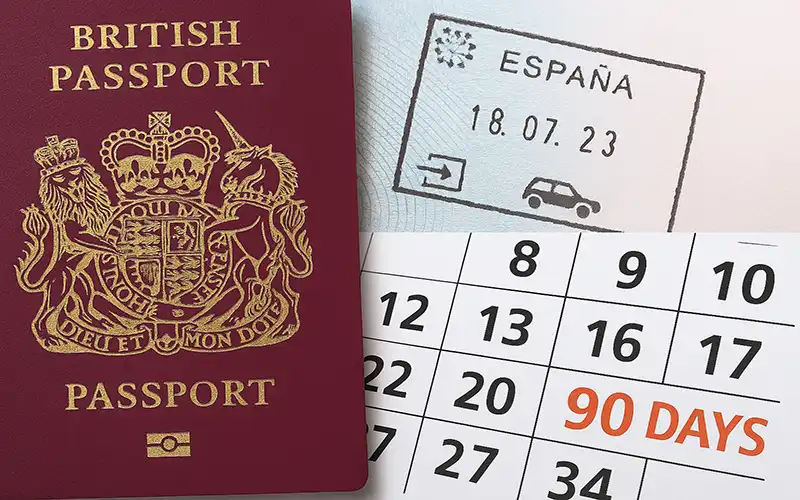
Since Brexit, visitors from the United Kingdom (UK) follow the same rule as Americans. The 90 days in any 180 are counted across the whole Schengen area (the European zone without internal border checks), not just Spain.
Facts checked on 9 November 2026.
How long you can stay in Spain without a visa
As a tourist from outside the EU, Iceland, Liechtenstein, Norway and Switzerland, you can stay in Spain for up to 90 days in any 180-day period. This is the 90/180 rule, and it is EU law.
The 180 days roll forward every day. On any day of your stay, look back 180 days and add up the days you have spent in the Schengen area. The total must be 90 or fewer. People often count from 1 January, or from the day they last arrived. Neither works.
- The day you arrive and the day you leave both count.
- One count covers all 29 Schengen countries, not just Spain.
- Days on a Spanish long-stay visa or residence permit do not count.
- There is no limit on the number of trips, only on the total days.
Over a whole year, the 90/180 rule gives you about half the year in Spain at most. Anyone who spends more than 183 days in Spain in a calendar year is also tax resident here. If you also hold an Irish passport, travel on it, and the 90-day limit does not apply to you.
After 90 days in Spain, when can you come back?
If you have just spent 90 days in a row here, you need 90 days in a row outside the Schengen area before you have a fresh 90. After shorter trips, each day comes back to you once it drops out of the 180-day window. A weekend in the UK or Morocco does not reset anything. It only pauses the count. Since 15 July 2026, days in Gibraltar count towards the 90 as well.
Check your dates on the European Commission's short-stay calculator. The EU's Check how long you can stay tool shows the days you have left, but it ignores stays that began before 10 April 2026. Keep your boarding passes in case your record is ever wrong.
How strict is the 90-day rule in Spain, and how is it enforced?
Very strict. The EES has run in full at every external Schengen border since 10 April 2026, and passport stamps ended that day. On your first trip it takes four fingerprints and a photo of your face. After that, it records every time you come in and every time you leave.
If you stay too long, the system puts you on a list of overstayers that passport and immigration officers can see. If you have already used 90 days of the last 180 when you arrive, you are refused entry. Officers can also ask for a return ticket and proof of money, which in 2026 is €122 a person a day, with a minimum of €1,099. Our article on the EU biometric border checks has more.
Brits overstaying in Spain: who gets caught and fined
People do get fined for overstaying in Spain, and British visitors are treated like any other visitor from outside the EU. An overstay of even one day now shows up on the EES the moment you pass through passport control. A case can then be opened against you, and it can end in a fine of €501 to €10,000 or in expulsion with an entry ban, as the next section explains.
Expulsion happens too. In a Spanish case that reached the EU Court of Justice in 2022, a tourist who stayed on after her 90 days was given an expulsion order with a 3-year ban on returning.
The European Commission's 2026 Schengen report shows how often overstays are now caught. While the EES was being phased in, almost 7,000 travellers were refused entry because they had overstayed. That figure covers the whole Schengen area and counts only people turned away at the border. Plan on the basis that an overstay will be noticed.
Private cover in Spain
Pick up your Sanitas quote
See a doctor or specialist privately instead of waiting your turn. Sanitas plans from €22,10 a month.
Your saved quote is ready whenever you are. Compare plans and finish in minutes.
Get a price My quotesWhat happens if you overstay in Spain
Spain's immigration law, Organic Law 4/2000, treats staying on after your 90 days as a serious offence (article 53.1.a). It is an administrative offence, not a crime.
| Penalty | What the law says |
|---|---|
| Fine | €501 to €10,000, based on the case and what you can afford (article 55) |
| Expulsion | Instead of a fine, after a formal case. Never both (article 57) |
| Entry ban | Comes with expulsion. Up to 5 years, or 10 in exceptional cases (article 58) |
| Time to leave | Usually 7 to 30 days. Immediate only under the fast-track procedure (articles 63 and 63 bis) |
| Detention | Up to 60 days in an immigration detention centre, ordered by a judge. Not prison (Royal Decree 1155/2024, Spain's immigration regulation, article 245) |
The ban goes into the Schengen Information System, the database that border police across Europe share, so in practice it covers the whole Schengen area. A fine does not make your stay legal either. You still have to leave, as the EU Court of Justice confirmed in that 2022 case.
If you have already overstayed, leave as soon as you can. Leaving while a case is open means no entry ban, and leaving within the time you are given cancels any ban, but only if your exit is reported. Ask the border police at the airport or port to record your departure on the official exit form. Or, once home, take proof of the date you left to the Spanish consulate in your country. That record is what shows you left in time.
Valid reasons for overstaying, and what to do if you cannot leave in time
There is no grace period for honest mistakes. A valid reason is something serious you could not foresee or prevent, such as an accident or a stay in hospital. Losing track of the date is not one. Book your flight home well before day 90, so a cancelled or delayed flight does not push you over.
If something serious keeps you here, apply for a stay extension (prórroga de estancia) before day 90. You apply in person at the police station where you are staying, on form EX-29. It is given only for exceptional reasons, adds up to 3 months and covers Spain only. Article 49 of Royal Decree 1155/2024 asks for these documents.
- A passport valid beyond the extension.
- Proof of the exceptional reason.
- Proof of money for the extra time.
- Travel insurance with the same cover as a short-stay visa.
- A ticket home dated before the extension ends.
No answer by the deadline counts as a refusal. If you are refused, leave before your 90 days end, or within 72 hours at most if they have already ended. Our guide to the stay extension in Spain has more detail.
If illness or an accident makes you overstay before you can apply, keep every document. With credible evidence, such as proof of hospital treatment, your EES record can be corrected and your name taken off the overstayer list.
Own a home in Spain? You are still counting days
Owning a home here gives you no right to stay past 90 days, even if you pay local taxes on it. Buying property no longer leads to residence either, because Spain ended the golden visa (the investor residence visa) on 3 April 2025. Our guide for swallows and second-home owners covers people who come out every winter.
How to spend more than 90 days in Spain legally
To stay longer, you need a visa. These are the usual routes, with the 2026 figures.
- Non-lucrative visa, for living on your own income without working. €2,400 a month (€28,800 a year), plus €600 a month for each dependant. Apply at the Spanish consulate where you live, not from Spain.
- Digital nomad visa, for remote work for companies or clients outside Spain. You need at least twice Spain's minimum wage. In 2026 that is €2,442 a month, plus €916 for the first family member and €305 for each further one. You can apply for the permit from inside Spain while here lawfully.
- Student visa, for a place on a course. €600 a month, unless your accommodation is prepaid. Adults in higher education can apply from inside Spain while here lawfully, at least 2 months before their legal stay as a visitor ends and at least 2 months before the course starts. On a 90-day visit, that means applying within your first month.
There are other routes too, such as a work visa, the self-employed visa, or family reunification if your husband or wife already lives in Spain legally.
Visitors must leave before their 90 days end unless they have applied for a permit, so start any application from Spain early.
What the visa insurance must cover
For the non-lucrative and digital nomad visas, the insurance has to come from an insurer authorised to operate in Spain, and it has to cover everything Spain's public health system covers. Choose a plan with no co-payments (no charge each time you see a doctor). Some consulates also ask for no waiting periods. The Los Angeles consulate says so on its own page, and the checklist for the Manchester consulate asks for it too. Read your own consulate's list before you buy. Travel insurance is not enough.
The start date on your insurance certificate must match your visa, and the cover must run for at least your first 12 months. A first non-lucrative permit lasts one year from the day you enter Spain. A digital nomad visa lasts up to one year, and a digital nomad permit applied for inside Spain can last up to 3 years.
We have been Sanitas agents in Marbella since 2011, and we arrange Sanitas plans that meet these rules. For a visa, the plans are Sanitas Mas Salud, Sanitas Mas Salud Family or Sanitas Top Quantum, all without co-payments. If you also want cover outside Spain, choose Sanitas Mas 90 without co-payments or Sanitas Premium 500. You can take these out up to 2 months before the cover starts. They have waiting periods for some treatments, but never for emergencies.
If your consulate asks for no waiting periods, or you need your certificate more than 2 months ahead, choose Sanitas Residents Visa: it has no waiting periods at all and can be taken out up to 5 months ahead. New policies are taken up to age 75 on Mas Salud, Mas Salud Family, Top Quantum and Residents Visa, and up to age 64 on Mas 90 and Premium 500, with no upper age to stay insured.
The certificate and the policy are in Spanish, because the consulate requires it. You deal with us in English throughout. We time the policy start to your consulate appointment and send you the certificate. Sanitas may accept, exclude or decline a condition you already have. If it excludes one, let us know before your appointment and we will check the certificate against your consulate's wording.
Our page on health insurance for your Spanish visa has more detail.
Get a visa health insurance quote
Living in Spain since before 2021? Your residence card stops the count
If you lived in Spain before 1 January 2021, the Withdrawal Agreement (the Brexit treaty for people already living in the EU) covers you. Spain says only the foreigner's identity card (TIE) issued under it keeps your days out of the EES count. The TIE also exempts you from the European Travel Information and Authorisation System (ETIAS), the online travel permit still to come. The old green residence certificate is not enough. If you still hold one, swap it for a TIE as soon as you can, as our guide to moving to Spain from the UK explains.
Americans, Canadians and Australians get the same 90 days
An American can stay in Spain for up to 90 days in any 180-day period without a visa, the same as a British visitor. Canadians and Australians get the same rule. Every visitor who falls under the 90-day rule, British visitors included, needs a passport issued in the last 10 years and valid for at least 3 months after the day they plan to leave the Schengen area.
Your EES record is tied to your fingerprints and face, so a second non-EU passport does not start a new count. See our guides for Americans and Australians, or our page on visa requirements for Spain.
Is Spain changing the 90-day rule?
No. The 90 days in any 180 is EU law, so Spain cannot change it on its own. All it can do is grant a stay extension in exceptional cases, valid in Spain only. The European Commission is studying longer short stays for a few jobs, such as touring artists, but nothing has been adopted, and tourists are not part of it.
ETIAS is not running yet and has no start date. It will cost €20, and the EU will announce the date months ahead on the official ETIAS website.
Penalties will get tougher. From 17 October 2027, new EU return rules allow entry bans of up to 10 years, or 20 in exceptional cases, even when an overstay is only found as you leave. If you want more than about half the year in Spain, plan for a visa.
Frequently asked questions
What happens if you overstay in Spain by a few days?
Even a short overstay is a serious offence under Spain's immigration law, Organic Law 4/2000. You can be fined €501 to €10,000, or expelled with a ban on returning of up to 5 years, but never both. The Entry/Exit System flags the overstay automatically. Leave as soon as you can, make sure your exit is recorded, and keep evidence of anything you could not foresee, such as a stay in hospital.
Has anyone been fined for overstaying in Spain?
Yes. People do get fined for overstaying in Spain, and British visitors are treated like any other visitor from outside the EU. The fine is €501 to €10,000, or you can be expelled with a ban on returning of up to 5 years instead. The Entry/Exit System flags an overstay of even one day at passport control.
Can I leave Spain for a weekend to reset the 90 days?
No. Leaving only pauses the count, and each day stays in your total until it drops out of the 180-day window. After 90 days in a row, you need 90 days in a row outside the Schengen area. Since 15 July 2026, days in Gibraltar count towards the 90 as well.
How many times can I visit Spain in a year?
As many times as you like. There is no limit on the number of trips, only on the total days, which must stay within 90 days in any 180-day period. Over a whole year, that gives you about half the year in Spain at most.
Does a stay extension in Spain let me visit other Schengen countries?
No. A stay extension (prórroga de estancia) covers Spain only. It is given only for exceptional reasons and adds up to 3 months. You apply in person at the police station where you are staying, before day 90.
Will ETIAS change the 90-day rule?
No. The European Travel Information and Authorisation System (ETIAS) is not running yet and has no start date. When it starts it will cost €20, and the limit stays at 90 days in any 180.
More in Visa rules, refusals and law changes 9 guides and 2 articles
 Spain Entry Requirements: What You Need To Know For A Visa-Free Stay
 Why Your Spanish Visa Application May Get Rejected And How To Appeal
 Visas Requirements For Americans In Spain
 Do Australians Need a Visa for Spain? Spain Visa Requirements
 Stay in Spain Over 90 Days: Prórroga de Estancia
Read next



Reviewed by Sean Guy, authorised Sanitas agent (agent code 22395) and DGSFP-registered insurance mediator (C0320X5769518Z), Marbella.
Written by the HealthPlan Spain team: English-speaking Sanitas health insurance specialists, helping expats in Spain get the right cover since 2011. Authorised and regulated by the DGSFP.