You cannot reliably pick out an unmarked police car in Spain before it stops you, and that is the whole point of it. The Guardia Civil traffic group uses cars, vans and motorcycles with no markings, the fleet changes, and no official list of models, colours or number plates is published. What you can recognise is a genuine stop: the police vehicle comes up behind you showing blue emergency lights and a red light flashing towards you, and you must then pull in on the right, in front of it, in a safe place. If you doubt that the people stopping you are real officers, the Guardia Civil's own advice is to call 062 or 112.
Living in Spain Police and paperwork
How To Identify An Unmarked Spanish Police Car

This guide explains what unmarked vehicles are used for, how a real stop is signalled, what a genuine roadside fine looks like and what to do if you are unsure. It was checked against Spain's traffic law, the circulation regulation and the publications of the Dirección General de Tráfico (DGT), Spain's national traffic authority, and of the Guardia Civil in November 2026.
What Unmarked Police Vehicles Are Used For
On roads outside towns, traffic is watched by the traffic group of the Guardia Civil (Agrupación de Tráfico), working with the DGT. Spain has more than one police force, and our guide to the police in Spain explains who does what.
The DGT is open about the fact that unmarked vehicles are on the road. This is what it has published:
- Mobile phone and seat belt checks: in its press release of 26 August 2026 for the end of summer traffic operation, the DGT listed unmarked vans and motorcycles among the means it uses to check mobile phone use, seat belt use and the other rules of the road, alongside fixed and mobile speed cameras, helicopters, drones and cameras.
- Offences on the move: a DGT press release of 27 August 2026, for a motorcycle Grand Prix weekend, said that unmarked vehicles would be used to detect offences committed on the move.
- Speed: the DGT's magazine reported in December 2024 that the traffic group operates 430 mobile speed cameras, which are set up on tripods at the roadside, carried in patrol cars or hidden inside the car itself.
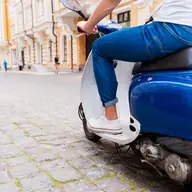
- Unmarked motorcycles: the magazine reported in June 2024 that the traffic group had 33 unmarked motorcycles, in ordinary showroom colours and of different makes and models. A uniformed unit works with them, and it is that unit which notifies the driver of the offence.
The DGT does not publish a current count of unmarked cars, so we do not give one. The last figure it gave for unmarked vans was 15, in August 2021. Lists of "known" models, colours or number plate letters that go round in the press and on social media are not official, and they go out of date as vehicles are replaced.
Speed cameras are a subject of their own: see our guides to speed camera apps and radar detectors in Spain and to a speeding ticket with no photograph.
How To Know If You Have Been Pulled Over By Real Traffic Police
Spain's circulation regulation (Reglamento General de Circulación) sets out how a police vehicle orders a driver to stop, and it makes no distinction between marked and unmarked vehicles:
- Blue lights. A police vehicle on urgent duty announces itself with its blue emergency lights, with or without the siren. Only priority vehicles, such as those of the police, the fire service and the ambulance service, are allowed to fit and use them.
- A red light flashing towards you. When the police vehicle places itself behind you and also switches on a red light that flashes forwards, you must stop.
- Where to stop. Pull in carefully on the right, in front of the police vehicle, in a place where you do not create a danger or a nuisance for other road users.
- Stay in the car. The regulation says the driver remains inside the vehicle and follows the instructions the officer gives by loudspeaker, or by any other means that can be clearly understood.
- A hand signal. An officer in a vehicle may also hold an arm out, pointing downwards and still. That too means stop on the right.
The DGT's magazine gave the same description in a video made with the traffic group in July 2016: an official vehicle that wants you to stop switches on a flashing red light together with its blue lights, and you pull in on the right in a safe place.
Other "tells" you may read about, such as an illuminated sign in the rear window or the number of officers in the car, are not in the regulation, so do not treat them, or their absence, as proof either way. As for uniforms, the Guardia Civil's advice for visitors points out that each police force in Spain has its own uniform.
Stopping is not optional. Ignoring the signals or orders of traffic officers is a serious offence under the traffic law, with a fine of €200 and the loss of four points from a Spanish driving licence.
Road accidents are normally excluded
Pick up your Sanitas quote
Most health policies will not treat you if you are hurt on the road or at work. Top Quantum and Professional plans include it free.
Your saved quote is ready whenever you are. Compare plans and finish in minutes.
- Free on Top Quantum
- Free on Professional plans
What A Genuine Roadside Fine Looks Like
If you are unfortunate enough to be fined, the general rule in the traffic law is that the officer gives you the written notice (boletín de denuncia) there and then. The law does not say whether it has to be printed or written by hand. It says what the notice must contain:
- the vehicle and, if it is known, who is being reported;
- a short description of what happened, with the place, the date and the time;
- the officer's professional identification number;
- the offence, the fine and any licence points that go with it;
- the authority that deals with the fine;
- that you have 20 calendar days to pay with the reduction or to object.
If you pay at the roadside, the amount you paid must be written on the notice. A demand for money with no written notice is not how a real fine works. Fake fines that arrive by text message, by email or under a windscreen wiper are a different trick, covered in our guide on how to tell if a traffic fine in Spain is fake.
Whether you can leave the fine to pay later depends on where you live. For a driver who cannot show that they live legally in Spain, the officer sets the amount on the spot and it must be paid as a deposit, by card or in cash in euros, with the 50% reduction for prompt payment taken into account. If it is not paid, the vehicle is immobilised in the place the officer indicates. So if you live here, carry your residence document, which shows your NIE number, as well as your licence. Visitors should have their passport with them: see do you have to carry ID in Spain?
Your driving licence matters too. If you live in Spain, a UK licence is valid for six months from the date you become resident, and you must then swap your UK driving licence for a Spanish one.
What Documentation Will I Be Asked For?
The traffic law obliges every driver to carry three documents and to show them to traffic officers who ask for them. Our guide to the documentation that you must carry with you when driving here in Spain covers each one, along with the equipment the car must have.
- Valid driving licence
- Log Book - Permiso de Circulación
- ITV card (Inspección técnica de vehículos)
The car's insurance must be in force, but the policy or receipt does not have to be carried in a Spanish-registered car. The European accident form (in Spanish "parte de declaración amistosa de accidentes") is worth keeping in the glove box for use after an accident, but it is not compulsory.
What If You Are Still Unsure?
So you've been signalled to stop, but you still have a suspicion that the vehicle, or the people in it, are not genuine. What do you do?
Do not ignore the signal. Pull in on the right in a safe place, as the regulation says, and stay in the car. The Guardia Civil's published advice for travellers is short: if at any time you distrust a supposed police officer who asks you for documents or belongings, call 062 or 112. The number 062 is the Guardia Civil's own, and 112 is the general emergency number. Tell the operator where you are and what is happening.
Learn more about how to pay a traffic fine in Spain, including the 50% reduction for paying within 20 calendar days.
Sources
BOE: circulation regulation, articles 68, 69 and 141 and annex I (in Spanish)
BOE: traffic law, articles 59, 76, 80, 87 and 89 (in Spanish)
DGT: press release listing unmarked vans and motorcycles (August 2026, in Spanish)
DGT magazine: the traffic group's unmarked motorcycles (June 2024, in Spanish)
Guardia Civil: advice for travellers, including what to do if you distrust a supposed police officer (in Spanish)
More in Police, scams and official paperwork 17 guides and 1 article
 How To Report A Burglary Or Theft In Spain
 How To Secure Your Property In Spain
 CCTV in Spain: Are Home Security Cameras Legal?
 How To Apply For A Criminal Record Certificate In Spain
 Do You Have To Carry ID In Spain?
Read next

Reviewed by Sean Guy, authorised Sanitas agent (agent code 22395) and DGSFP-registered insurance mediator (C0320X5769518Z), Marbella.
Written by the HealthPlan Spain team: English-speaking Sanitas health insurance specialists, helping expats in Spain get the right cover since 2011. Authorised and regulated by the DGSFP.