PET Scan in Spain: Cost, Sanitas Cover and What to Expect
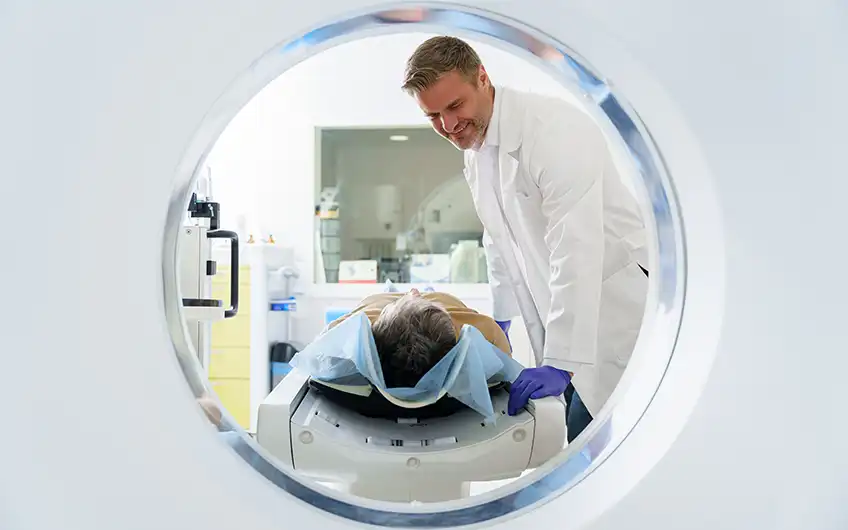
A private PET scan in Spain costs about €950 to €1,100 when booked through an online marketplace. In September 2026 a Madrid nuclear medicine unit listed a PET-CT with contrast and report at €993 (list price €1,092) and a Barcelona unit from €949; the hospital groups quote on request. With Sanitas the same scan costs €0 on Sanitas Mas Salud and the other plans without copayments. On Mas Salud Optima and Sanitas Avanza it is a €12 copayment, and on Mas Salud Plus one service on the copayment ladder. That is once a doctor in the Sanitas network has prescribed it and Sanitas has authorised it. There is a six-month waiting period for complex diagnostic tests on a new policy, which Sanitas can set aside for a life-threatening illness that appears after the start date. Sanitas Accede and Sanitas Unico do not cover PET. In Spanish the scan is a PET or, combined with a CT scan, a PET-TAC.
This guide gives the cost, and which Sanitas plans cover a PET (positron emission tomography) scan and what each charges. It explains the waiting period and its exceptions, how to get one with Sanitas step by step, and where the network does them. Then comes the medical side: what a PET scan is and shows, why a doctor orders one, and the Spanish names for the scans you will meet. It ends with how the scan is done, the risks, and what a positive result can mean besides cancer. A copayment, where the word appears, is a small fixed charge billed to your account with a later premium, not paid at the unit. The medical information follows the guidance of the NHS (the UK's National Health Service), Cancer Research UK and the British Nuclear Medicine Society; the cover details are taken from Sanitas' general conditions.
PET scan cost in Spain: private prices against Sanitas
The main private hospital groups (Quironsalud, Vithas, HM Hospitales, Hospiten, the Clinica Universidad de Navarra, Ruber and Teknon) do not publish a PET-CT price; each quotes on request. The table shows the published private prices in Spain, with UK prices alongside for anyone weighing a private scan in Spain against one at home.
| How you pay | Cost per PET-CT | Notes |
|---|---|---|
| Sanitas Mas Salud, Family, Top Quantum, Mas 90, Premium 500, Professional, Students | €0 | Covered in full once prescribed and authorised |
| Sanitas Residents Visa | €0 | Covered in full once prescribed and authorised, with no waiting period |
| Sanitas Mas Salud Optima | €12 copayment | Billed with a later premium; no annual cap |
| Sanitas Mas Salud Plus and Professional Plus | One service on the ladder | First six services a year free, then €4 to €10; capped at €360 a year |
| Sanitas Avanza | €12 copayment | Capped with all copayments at €350 a year |
| Sanitas Mas 90 Plus | €5 copayment | Flat charge for most services |
| Sanitas Accede or Unico | Not covered | You pay the private price |
| Private, Affidea PET La Milagrosa, Madrid, via the ClinicPoint marketplace | €993 (list €1,092) | PET-CT with contrast, a preparation phone call and the report in three to four days; a prescription is required; allow three hours |
| Private, Barcelona nuclear medicine unit via the tuMedico marketplace | From €949 | FDG PET for cancer with report; a prescription is required |
| Private, United Kingdom (FDG PET-CT) | £1,800 to £2,096 | Circle Health from £1,800, MyScan £1,800, Alliance Medical from £2,096 depending on tracer; PSMA scans from £3,100 |
Our guide to how copayments work has every plan's schedule. A Sanitas member is scanned at a network nuclear medicine unit and does not pay at the desk; any copayment is normally billed with a later premium.
Which Sanitas plans cover a PET scan?
Every full-cover Sanitas plan and Sanitas Avanza include PET in their nuclear medicine benefit. Sanitas covers positron emission tomography alone or combined with computed tomography (PET-CT), with three tracers for the cases listed in the conditions. The sugar tracer, 18F-FDG (fluorodeoxyglucose), is covered for diagnosing and staging cancer, monitoring the response to treatment and, where reasonable, detecting recurrence, and for a list of non-cancer indications. Choline is covered for high-risk prostate cancer staging, locating a recurrence when the PSA (prostate-specific antigen) rises, and parathyroid adenoma. PSMA (prostate-specific membrane antigen) tracers are covered for high-risk prostate staging and for suspected recurrence after initial curative treatment, when the PSA is rising and other tests are negative. PET-MRI is covered for cancer only; if you are on Top Quantum, ask us to confirm PET-MRI before you rely on it. Every PET needs Sanitas' prior authorisation after it has evaluated the doctor's report, and it must be for diagnosis, not screening. Mas Salud Optima, Mas Salud Plus and the Professional plans follow the same rules as Mas Salud.
| Plan | PET-CT covered? | You pay | Waiting period |
|---|---|---|---|
| Sanitas Mas Salud, Mas Salud Family | Yes | €0 | 6 months |
| Mas Salud Optima | Yes | €12 | 6 months |
| Mas Salud Plus | Yes | One service on the ladder | 6 months |
| Top Quantum | Yes (ask us about PET-MRI) | €0 | 6 months |
| Mas 90, Premium 500 | Yes | €0 | 6 months |
| Mas 90 Plus | Yes | €5 | 6 months |
| Sanitas Professional, Professional Plus | Yes | €0, or one service on the Plus ladder | 6 months |
| Residents Visa | Covered, with prior authorisation, for the same indications as the full-cover plans | €0 | None |
| International Students | Yes | €0 | None |
| Sanitas Avanza | Yes | €12 | 6 months |
| Sanitas Accede | No: complex tests excluded apart from ultrasound and echocardiograms in the consultation | Private price | Not applicable |
| Sanitas Unico | No: only ultrasound, CT and MRI among complex tests | Private price | Not applicable |
Two more rules from the conditions. A scan is only covered for the indications listed, so a PET requested to screen a healthy person, or with a tracer outside the three named, is not paid. And a condition that existed before you joined is a pre-existing condition: if it was not declared on the health questionnaire, the authorisation for anything relating to it is not valid. Our guide to pre-existing conditions explains what to declare. If you are on Accede or Unico and a PET has already been requested, moving to a fuller plan will not help for that scan. The condition has to be declared as pre-existing on the new plan, where Sanitas can exclude it or surcharge it, and the six-month wait for complex tests starts again. If you are also registered with the public system, PET-CT is in its catalogue, so ask your specialist about a public referral.
The waiting period for a PET scan
Complex diagnostic tests carry a six-month waiting period on every plan except Residents Visa, International Students and company-paid business plans, which have none. The conditions define them to include nuclear medicine, CT, MRI (magnetic resonance imaging), endoscopy and genetic tests. Three things change that. The wait does not apply to an illness that is life-threatening, unexpected and diagnosed after the policy started. Sanitas decides that case by case when it reads the report, and a request inside the six months is marked as being validated rather than refused outright. Sanitas normally waives the wait when you are switching from another Spanish insurer, or from Bupa, after at least a year of full cover with proof of continuous cover. Childbirth keeps its wait, and the waiver applies to the medical-network side of a plan, not to the reimbursement route on Mas 90 or Premium 500. And the wait starts again if you move to a different Sanitas plan, so time a plan change with care; see our guide to changing plan. Our guide to waiting periods lists every plan's waits, and our waiting-periods FAQ answers the common questions. If you are inside the wait with an urgent request, call us on 952 835 600.
How to get a PET scan with Sanitas, step by step
- See the specialist. With Sanitas you book the specialist directly; our guide to seeing a specialist without a referral explains the rule. For a PET that is usually the specialist treating you. If you already have a diagnosis, say so when you apply for the policy; that is handled as a pre-existing condition, not by the waiting period.
- The prescription. The conditions require a written prescription from a doctor in the Sanitas network. The specialist gives you the request slip, the volante, and writes the report Sanitas will read.
- Authorisation. In the app go to More, then Administrative Procedures, then Authorisations (Mas, Gestiones, Autorizaciones if your app is in Spanish), tap Request new authorisation and enter the document number printed on the volante. The approval appears there and the slip can be downloaded. A request that touches a waiting period or an undeclared condition is marked as being validated (en proceso de validacion), which means Sanitas studies the report before deciding. When a request is under validation, Sanitas contacts you within 48 hours. If you prefer not to use the app, call us on 952 835 600 and we arrange the authorisation with Sanitas for you. If nothing has arrived after 48 hours, or a request is refused, we follow it up with Sanitas and help you ask for the reason in writing.
- Book the unit. Choose a nuclear medicine unit from the network, in the app or from our nuclear medicine directory, and phone it; not every nuclear medicine unit has a PET-CT scanner, so ask. The unit will ask about diabetes, pregnancy and breastfeeding, and give you the fasting instructions below.
- On the day. Take your Sanitas card, on your phone or the plastic one, photo ID and the volante. You do not pay at the desk; any copayment is billed later.
- The report. The nuclear medicine specialist's report goes to the doctor who ordered the scan, who explains it to you and decides the next step. In the app, under More, then My Health, then Medical reports, you find the reports uploaded to it.
Where a PET-CT is done in the Sanitas network
The tracer is made for each patient on the day and lasts only hours, and the scan needs a nuclear medicine department, so PET-CT is done in fewer places than an MRI. Our nuclear medicine directory lists 43 Sanitas nuclear medicine locations in 23 provinces as at August 2026, with 66 named specialists, plus three more units in Almeria and Tenerife. Not every nuclear medicine unit has a PET-CT scanner, so phone the unit first. The largest concentration is Barcelona with seven locations, including Quironsalud's El Pilar and Barcelona hospitals. Madrid has four, including Hospital Blua Sanitas Valdebebas with its digital PET scanner. Malaga has three, among them Hospital Quironsalud Malaga, and the directory lists three each in Seville, the Balearics and Zaragoza. Valencia, Alicante and Pontevedra have two, and a further 14 provinces have one. Sanitas' own Hospital CIMA in Barcelona also offers PET-CT. If your province has none, you can use a network unit in any other province; cover is not tied to where you live. Call us on 952 835 600 and we tell you the nearest one.
What is a PET scan and what does it show?
A PET scan, positron emission tomography, shows how active the body's tissues are rather than what they look like. You are injected with a tracer, most often a form of glucose tagged with a small amount of radioactive fluorine-18; the combination is FDG. Cells that use a lot of sugar, which includes many cancer cells but also inflamed or infected tissue, take up more of it and appear as bright areas on the images. Most PET scans today are PET-CT: a CT scan taken in the same machine at the same time gives the anatomy, so the doctor sees exactly where the active area sits. Sanitas also covers PET-MRI, which pairs PET with an MRI instead of a CT, for cancer.
Doctors order a PET-CT mainly for cancer: to find it, to stage it, to see how treatment is working and to look for a recurrence. The other reasons Sanitas covers start with the heart. It covers checking whether heart muscle is still alive in people with serious left-ventricle weakness who are being considered for a bypass or stent, when ordinary heart imaging has not settled it. Then come the seizure focus before surgery in partial temporal-lobe epilepsy, fever of unknown origin, and suspected long-standing infection of bone or spine, including around metal implants. The list ends with a painful hip replacement, an infected vascular graft, a diabetic foot with suspected infection, bacteraemia or endocarditis, sarcoidosis, inflammatory bowel disease, large-vessel vasculitis and a rare parasitic infection (alveolar echinococcosis). A PET is not a screening test for healthy people, and dementia scans with amyloid tracers are not in the Sanitas list. Your specialist chooses between MRI, CT and PET; our MRI guide explains what each of the first two shows.
PET scan in Spanish: PET, PET-TAC and TEP
In Spanish a PET scan is simply un PET, and combined with a CT scan, which is how most are done, it is a PET-TAC or PET-TC. The full name, tomografia por emision de positrones, appears on reports and in the public health catalogue and is abbreviated TEP. PET-MRI is PET-RM. The department is medicina nuclear, the doctor is an especialista en medicina nuclear, the tracer is the radiotrazador or radiofarmaco, and the sugar tracer is FDG or fluorodesoxiglucosa. Around the scan you will meet the other scan names. TAC (tomografia axial computarizada) is a CT scan, resonancia magnetica or RM is an MRI and ecografia is an ultrasound. A gammagrafia is any scan with a gamma camera, for example a bone or thyroid scan, also done in nuclear medicine. The request slip is the volante, the report is the informe, and en ayunas means fasting. At the desk: tengo cita para un PET-TAC (I have an appointment for a PET-CT) and vengo en ayunas (I have fasted).
How is a PET scan done? What happens on the day
- Before. Fast for four to six hours as the unit instructs; water is fine. Avoid strenuous exercise for 24 hours, because exercise can affect the results. Wear loose clothes with no metal. If you are diabetic, tell the unit when you book: your glucose is checked on arrival and your medication is planned around the fast. The British Nuclear Medicine Society warns the scan may be postponed if your sugar is too high. The tracer is made for you on the day, so most units charge for a missed slot unless you cancel at least 24 hours ahead.
- The tracer. A small amount of tracer is injected into a vein in your arm. You then rest quietly for about an hour, sometimes up to two, while it spreads through the body.
- The scan. You lie on a narrow bed that moves slowly through the ring of the scanner. It is painless and not particularly noisy; you keep still and breathe normally. The scan itself takes 30 to 60 minutes, depending on the area covered. Expect two to three hours at the unit in all.
- After. You can eat and drink as normal. Drink plenty of water to flush the tracer out, and avoid close contact with pregnant women and young children for the rest of the day. There is normally no sedation, so you can drive home; if you are claustrophobic and are given something to relax you, Cancer Research UK says you need someone to take you home and stay overnight.
- The report. The nuclear medicine specialist sends the report to the doctor who ordered the scan; the Madrid unit in the price table delivers it in three to four days.
Risks and who should not have one
The radiation dose from a PET-CT is small but real. It is equivalent to roughly three to eight years of natural background radiation depending on the scan, and the Royal Marsden puts the added lifetime cancer risk below 0.1 per cent. It is justified when the scan changes a treatment decision. Sanitas, separately, authorises each scan after reading the doctor's report. Tell the unit if there is any chance you are pregnant; pregnancy is a contraindication. If you are breastfeeding, express milk before the scan and pause breastfeeding afterwards for as long as the unit tells you, which can be up to 24 hours. The NHS describes allergic reactions to the tracer as very rare.
A positive PET scan does not always mean cancer
Because the tracer goes wherever cells are busy, a bright area is not proof of cancer. The American Cancer Society says abnormal activity can be due to cancer, inflammation, infection, or changes from recent surgery or radiotherapy. Cancer Research UK notes that an area lighting up may be scar tissue rather than cancer. The reverse is also true. The American Cancer Society explains that cells take up the sugar tracer according to how fast they grow, so a cancer that grows slowly may take up less of it and show less clearly. That is why the PET report is read alongside your other tests by the specialist who ordered it, and why a biopsy may follow. Our guide to a cancer diagnosis explains what Sanitas covers from that point on.
Which plan, if a PET scan matters to you
- Full cover with nothing to pay: Sanitas Mas Salud covers PET-CT and PET-MRI at €0 after the six-month wait, with hospital treatment, chemotherapy and radiotherapy behind it.
- Full cover for less, with small copayments: Mas Salud Optima (€12 a scan) or Mas Salud Plus (one service on the ladder) give the same cover for a lower premium.
- Outpatient only, but with the complex tests: Sanitas Avanza covers PET-CT, MRI and CT at €12 each without hospital cover. Sanitas Accede does not include complex tests beyond ultrasound and echocardiograms in the consultation, and Sanitas Unico stops at ultrasound, CT and MRI.
- No waiting period: the International Students plan and Residents Visa, which both cover PET from the day the policy starts.
Ask us if you are choosing a plan with a family history or a diagnosis already in hand; the pre-existing rules decide more than the plan does.
Frequently asked questions
- How much does a PET scan cost in Spain without insurance?
-
Spain's private hospital groups quote for a PET-CT on request rather than publishing a price. Online booking marketplaces show €993 for a PET-CT with contrast and report at a Madrid nuclear medicine unit (list price €1,092), and from €949 for an FDG PET at a Barcelona unit. Both need a doctor's prescription. UK private providers charge from about £1,800 to £2,096 for an FDG PET-CT and from £3,100 for a PSMA scan. With Sanitas the scan costs €0 on Mas Salud and the other plans without copayments, €12 on Optima and Avanza, or one service on the Plus ladder, once authorised.
- Is a PET scan covered by Sanitas health insurance?
-
Yes, on the full-cover Sanitas plans and on Sanitas Avanza. A doctor in the Sanitas network must prescribe it for one of the indications in the policy conditions, and Sanitas authorises it after reading the medical report. Residents Visa covers PET too, with no waiting period. Sanitas Accede and Sanitas Unico do not cover PET: Accede excludes complex diagnostic tests apart from ultrasound and echocardiograms in the consultation, and Unico covers only ultrasound, CT and MRI among them.
- Is there a waiting period for a PET scan with Sanitas?
-
Six months from the start of the policy on every plan except Residents Visa, International Students and company-paid business plans, which have none. The wait does not apply to an illness that is life-threatening, unexpected and diagnosed after the policy starts, which Sanitas decides case by case on the medical report. Sanitas normally waives it when you switch after at least a year of full cover with another Spanish insurer or with Bupa. A condition you already had when you applied is a pre-existing condition, which is a different rule.
- How long does a PET scan take?
-
Plan on two to three hours at the unit. The tracer is injected and you rest for about an hour, sometimes up to two, while it spreads. The scan itself takes 30 to 60 minutes, depending on the area scanned. You can normally go home straight afterwards.
- What is the PET scan procedure, step by step?
-
You fast for about six hours and avoid strenuous exercise for 24 hours beforehand. At the unit your blood sugar may be checked, the tracer is injected into a vein, and you rest quietly for about an hour while it spreads. You then lie still on a bed that moves through the ring of the scanner for 30 to 60 minutes. Afterwards you drink plenty of water and avoid close contact with pregnant women and young children for the rest of the day. The report goes to the doctor who ordered the scan.
- What does a PET scan show?
-
How active the tissue is, rather than what it looks like. The tracer is a form of sugar tagged with a tiny amount of radioactivity; cells that use a lot of sugar, such as many cancers, take up more of it and show as bright areas. Combined with the CT taken in the same session, the doctor can see exactly where those areas are.
- If a PET scan is positive, can it be anything but cancer?
-
Yes. The American Cancer Society says abnormal activity on a PET scan can be due to cancer, inflammation, infection, or changes from recent surgery or radiotherapy. Cancer Research UK notes that a bright area can be scar tissue rather than cancer. That is why the report goes back to the doctor who ordered the scan, who reads it against your other results and may confirm with a biopsy.
- Will a PET scan pick up all cancers?
-
Not always. The American Cancer Society explains that cells take up the sugar tracer according to how fast they grow, so a cancer that grows slowly may take up less of it and show less clearly. The report is therefore read alongside your other tests rather than relied on alone.
- Why would a doctor order a PET scan? Do I have cancer if I need one?
-
Not necessarily. PET scans are ordered mainly for cancer: to find it, to stage it (see how far it has spread), to check how treatment is working and to look for a recurrence. Sanitas also covers it for a list of non-cancer reasons in its conditions. They include heart-muscle viability in serious left-ventricle weakness before a bypass or stent, when other heart imaging is inconclusive, and the seizure focus in partial temporal-lobe epilepsy before surgery. They also include fever of unknown origin, long-standing bone or spine infection, a painful hip replacement, sarcoidosis and large-vessel vasculitis.
- What is a PET scan called in Spanish?
-
Un PET, or PET-TAC (also written PET-TC) when it is combined with a CT scan, which is how most are done. The full Spanish name is tomografia por emision de positrones, abbreviated TEP in reference works such as MedlinePlus. PET-MRI is PET-RM. The department is medicina nuclear, the doctor is an especialista en medicina nuclear, the tracer is the radiotrazador or radiofarmaco, and the report is the informe.
- What is another name for a PET scan?
-
Positron emission tomography is the full name, and when it is combined with a CT scan in the same session, as most are today, it is a PET-CT (PET-TAC in Spain). Combined with an MRI it is a PET-MRI.
- What is a TAC scan in Spain?
-
A CT scan. TAC stands for tomografia axial computarizada, so a TAC is the X-ray-based cross-sectional scan English speakers call a CT or CAT scan. It is not a PET scan, although the two are combined in a PET-TAC. An MRI is a resonancia magnetica and an ultrasound is an ecografia.
- Do I need a referral for a PET scan?
-
You need a written prescription from a doctor in the Sanitas network, usually the specialist treating you, plus Sanitas' authorisation, which Sanitas grants after evaluating the doctor's report. You do not need a GP referral to reach that specialist: with Sanitas you book a specialist directly.
- Can I have a PET scan if I am pregnant, breastfeeding or diabetic?
-
Tell the unit if there is any chance you are pregnant; pregnancy is a contraindication. If you are breastfeeding, express milk beforehand and pause breastfeeding afterwards for as long as the unit tells you, which can be up to 24 hours. If you are diabetic, tell the unit when you book: the tracer is a form of sugar, so your blood glucose is checked on arrival. The British Nuclear Medicine Society warns the scan may be postponed if it is too high.
This page explains cover and the procedure; it is not medical advice. Your specialist decides whether a PET scan is right for you.
See what full cover costs you
Enter your date of birth and province for every Sanitas plan priced for you; the table above shows which ones cover PET-CT.