Moving to Spain from the UK on a non-lucrative visa costs a British adult about £700 in official fees before translations, a doctor’s certificate and postage: £516 for the visa, £9.60 for the residence authorisation, £14.85 for the visa centre, £70 for the police certificate and £45 for each of two apostilles. You must also show an income of €2,400 a month. Once you are here, everyday prices are lower: Eurostat, the statistics office of the European Union (EU), puts consumer prices in Spain at 91.6 per cent of the EU average for 2025 and those in the UK at 123.3 per cent, so the same basket costs about a quarter less in Spain.
Visas & Residency Moving to Spain
Cost of Moving to Spain from the UK
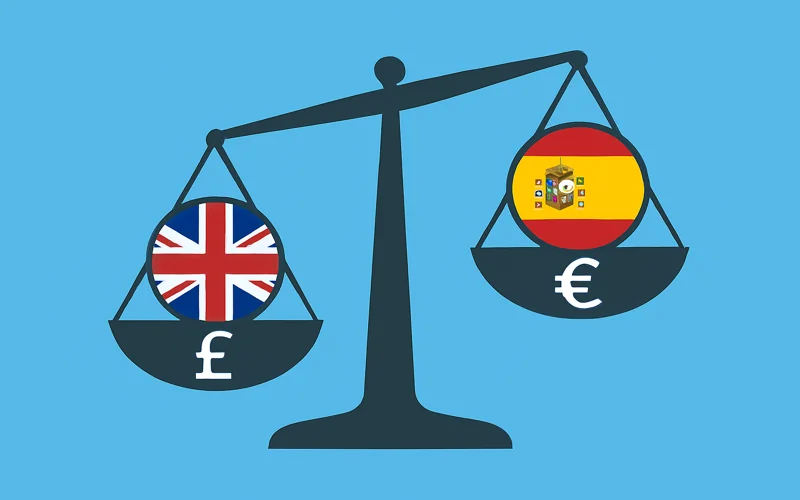
Every figure on this page comes from an official source and was checked on 14 November 2026. The first part covers the cost of the move itself. The second part compares the cost of living in the two countries.
Cost of Moving to Spain from the UK: Fee by Fee
A British citizen needs a visa to live in Spain. You apply for it in the UK, at the Spanish consulate that covers your home address, before you travel. You cannot arrive as a visitor and simply stay on. The one exception is the digital nomad visa, which can also be applied for from inside Spain while you are here legally. Our guide to moving to Spain from the UK takes you through the steps. This page deals with the money.
| Cost | Amount | Source and date |
|---|---|---|
| Non-lucrative visa, British citizen | £516 | Spanish consular fee list in force since 1 January 2026 |
| Digital nomad (teleworking) visa, British citizen | £719 | Spanish consular fee list in force since 1 January 2026 |
| Residence authorisation fee, paid with the non-lucrative visa | £9.60 | Spanish consular fee list in force since 1 January 2026 |
| Visa application centre service charge | £14.85 | Fee list in force since 1 January 2026 |
| UK police certificate from the ACRO Criminal Records Office | £70 | ACRO, November 2026. Allow up to 20 working days plus the post |
| Apostille on a UK document, for each document | £45 on paper, £35 electronic | UK Legalisation Office, November 2026. Postage or courier is extra |
| Foreigner’s identity card (TIE), first card | €16.08 | Spanish National Police fee list, November 2026 |
| Foreigner’s identity number (NIE), asked for on its own | €9.84 | Spanish National Police fee list, November 2026 |
Two costs have no official price. Any document that is not in Spanish needs a sworn translation, and each sworn translator sets their own fee. The medical certificate comes from a doctor, who will charge for it. The police certificate and the medical certificate each need an apostille, the stamp that confirms a document is genuine, which is why the total above counts two.
The foreigner’s identity number normally comes with the visa, so most people never pay the €9.84. The identity card is applied for at a National Police station within one month of arriving in Spain.
The Income You Must Show
The fees are the small part. For the non-lucrative visa the main applicant must show €2,400 a month (€28,800 a year), plus €600 a month for each dependant. That figure has not changed since 1 January 2023. For the digital nomad visa the consulates ask for €2,442 a month, twice the minimum wage, a figure in force since 1 January 2026. Our article on the minimum income for residency in Spain sets out every route, and we have separate guides to the non-lucrative visa and the digital nomad visa.
Health Insurance for the Visa
Both visas ask for private health insurance from an insurer authorised in Spain. It must cover everything the public health system covers, with no co-payments (no charge each time you see a doctor), and run for at least one year. Some consulates also ask for no waiting periods, so read your own consulate’s list. The price depends on your age and on where in Spain you will live, so we quote it person by person. Policy documents are issued in Spanish, which is what a consulate will want to see, and you can then switch them between Spanish and English whenever you like.
Bringing Your Belongings
The UK is outside the EU, so your furniture and personal belongings pass through Spanish customs. They come in free of customs duty and VAT when you move your home here, on conditions set by the Spanish tax agency. You must have lived outside the EU for at least 12 months in a row, you must have had the goods for at least six months, and you must bring them in within 12 months of becoming resident. Alcohol, tobacco and commercial vehicles are excluded. For 12 months afterwards you may not lend, pledge, hire out or hand over the goods without telling customs first. What a removal costs depends on how much you bring and how far it travels, and there is no official figure for it.
Cost of Living in Spain vs the UK: the Official Figures
The fairest single comparison is Eurostat’s price level index. It prices the same basket of goods and services in each country and sets the EU average at 100. In the figures for 2025, updated on 9 July 2026, household consumption stands at 91.6 in Spain and 123.3 in the UK. Prices in the UK are therefore about 35 per cent higher than in Spain. Eurostat now publishes only the overall figure for the UK, so the other rows show Spain against the EU average.
| What is measured | Spain in 2025 (EU average = 100) |
|---|---|
| Everything a household buys | 91.6 (UK: 123.3) |
| Food and non-alcoholic drinks | 95.3 |
| Alcohol and tobacco | 85.8 |
| Clothing and footwear | 89.4 |
| Housing, water, electricity and gas | 98.1 |
| Electricity, gas and other fuels on their own | 93.0 |
| Transport | 88.1 |
| Restaurants and accommodation | 85.4 |
| Recreation, sport and culture | 92.0 |
In plain words, Spain is cheapest against the EU average for eating out, drink and transport. Housing and household energy sit close to the average.
What Households Actually Spend
Spain’s National Statistics Institute reported on 25 June 2026 that the average household spent €35,101 in 2025, which is €14,066 a person. That is about €2,925 a month for a household and about €1,170 a month for one person. A third of it, 33.2 per cent, went on housing, water, electricity and gas. Food and non-alcoholic drinks took 16.0 per cent, transport 11.5 per cent, and restaurants and accommodation 9.3 per cent.
Where you live changes the figure a good deal:
| Region | Average spending per person in 2025 |
|---|---|
| Basque Country | €16,642 |
| Madrid | €16,124 |
| Catalonia | €15,017 |
| Balearic Islands | €14,217 |
| Spain as a whole | €14,066 |
| Valencian Community | €13,704 |
| Canary Islands | €12,652 |
| Murcia | €12,408 |
| Andalusia | €12,197 |
In the UK, the Office for National Statistics reported on 11 June 2026 that the average household spent £676.60 a week between April 2024 and March 2025, which is about £2,930 a month. The two surveys are not built in the same way. The Spanish figure includes an estimated rent for people who own their home, while the British housing line leaves out mortgage payments and council tax. Use them to see where the money goes, and use the Eurostat index above to compare prices.
Wages and VAT
Spain’s minimum wage has been €1,221 a month in 14 payments, or €17,094 a year, since 1 January 2026 under Royal Decree 126/2026. Our article on the minimum wage in Spain explains how it works. In the UK the National Living Wage for workers aged 21 and over has been £12.71 an hour since 1 April 2026, and it rises to £13.21 an hour on 1 April 2027.
The standard rate of VAT is 21 per cent in Spain and 20 per cent in the UK. Spain charges 4 per cent on basic foods and 10 per cent on most other food, while most food in the UK carries no VAT at all.
Housing: the Cost That Is Rising Fastest
Housing is the cost that has moved most. Spain’s official Housing Price Index for the second quarter of 2026, published on 7 September 2026, shows home prices 12.2 per cent higher than a year earlier: 7.4 per cent for new homes and 12.9 per cent for resale homes. Rents differ widely from one town to the next, so look at asking rents in the place you have chosen before you settle on a budget. Our article on renting vs buying property in Spain weighs the two.
The Exchange Rate
If your income is in pounds, the exchange rate decides what it is worth in Spain, and it moves every day. The European Central Bank publishes a reference rate for the euro against the pound each working day. We do not quote a rate here, because it would be out of date within hours.
Cover your visa will accept
Pick up your Sanitas quote
The consulate wants proper Spanish health cover, not travel insurance. Plans that qualify start at €61,40 a month.
Your saved quote is ready whenever you are. Compare plans and finish in minutes.
- No co-payments
- Accepted for visa and residency
Is Spain Still Cheaper Than the UK?
Yes. On Eurostat’s figures for 2025, the same basket of goods and services costs about a quarter less in Spain than in the UK. Against the EU average, Spain is cheapest for eating out, drink and transport, while housing and energy are close to the average and home prices are rising quickly. The minimum wage is lower here too, so the gain is greatest for people who arrive with a pension, savings or an income earned in pounds.
Before you move, set your UK monthly outgoings beside the Spanish figures above, and remember that where you live matters. Households in Andalusia and the Canary Islands spend well below the national average, and those in Madrid and the Basque Country well above it.
Thinking of making the move?
We arrange the health insurance your visa asks for and time its start date to your consulate appointment. For the first home, see our guide to renting long term in Spain.
Contact us or get started with our quick guide.
More in Moving to Spain 13 guides and 1 article
 Moving To Spain Checklist: What To Do And When
 What Living In Spain Is Really Like: Culture, Food And Daily Life
 Residency Options for Americans Moving to Spain
 Can I Retire To Spain As A UK Citizen?
 Moving to Spain from the UK: Visas, Healthcare and Who to Tell
Read next



Reviewed by Sean Guy, authorised Sanitas agent (agent code 22395) and DGSFP-registered insurance mediator (C0320X5769518Z), Marbella.
Written by the HealthPlan Spain team: English-speaking Sanitas health insurance specialists, helping expats in Spain get the right cover since 2011. Authorised and regulated by the DGSFP.